The Short Answer
A campaign library can reveal how products, messages, demonstrations and qualifications are distributed across several ads. One video might show a feature clearly; another supplies its name or a market-specific detail. Reviewing them together helps you find supporting material, notice gaps and prepare more complete answers. Keep each finding attached to its original source and check that the versions belong together. A collection gives you more evidence to work with. It does not make contradictory evidence agree simply because the files share a folder.
Key takeaways
- Look across the campaign. Different edits can contribute complementary details to the same customer question.
- Preserve the identity of each source. Product, market, version and date determine whether findings can be combined.
- Turn the collection into a working resource. Use it to prepare answers, identify missing information and support the next team’s brief.
Why does a single-video view have limits?
A video ad has a particular job. The main film might introduce an idea, a shorter edit might emphasise a product and a local version might carry the relevant offer. Each can be effective while containing only part of the information a later writer needs.
The campaign is therefore a useful unit of investigation. A product explanation may draw on a demonstration from one asset and an identifying detail from another. A campaign account may need the main film’s narrative alongside the cutdowns that adapted it for different settings.
Looking at one asset in isolation can hide that contribution. It can also encourage the writer to fill a gap with an assumption, especially when the missing information seems obvious to anyone who attended the original briefing. That is a surprisingly exclusive audience for a public article.
Analyse every ad through AdCyte and preserve its context. The resulting collection gives the team a broader starting point for questions, descriptions and other useful writing.
Which differences between campaign versions matter?
Begin with differences that could change the answer. Product variants, visible configurations, spoken claims, on-screen wording, markets and effective dates all deserve attention. A different soundtrack might affect a creative interpretation without altering a product fact.
Some versions contribute clarity rather than new information. A close-up may make a component easier to identify. A slower demonstration may explain an action more clearly. These are useful sources even where the underlying product message remains consistent.
| Campaign asset | Possible contribution | Context to preserve |
|---|---|---|
| Main brand film | Narrative, setting and campaign message | Campaign and intended audience |
| Product demonstration | The action or configuration shown | Product, model and visible components |
| Short cutdown | A concentrated proposition or pack shot | Exact edit and any changed wording |
| Market version | Local product details or offer language | Country, language and applicable period |
| Older campaign asset | Historic presentation or earlier product context | Original date and current relevance |
These distinctions should remain available after analysis. The collection becomes less useful if every record is reduced to the same generic description with a different filename at the top.
How do several videos contribute to one answer?
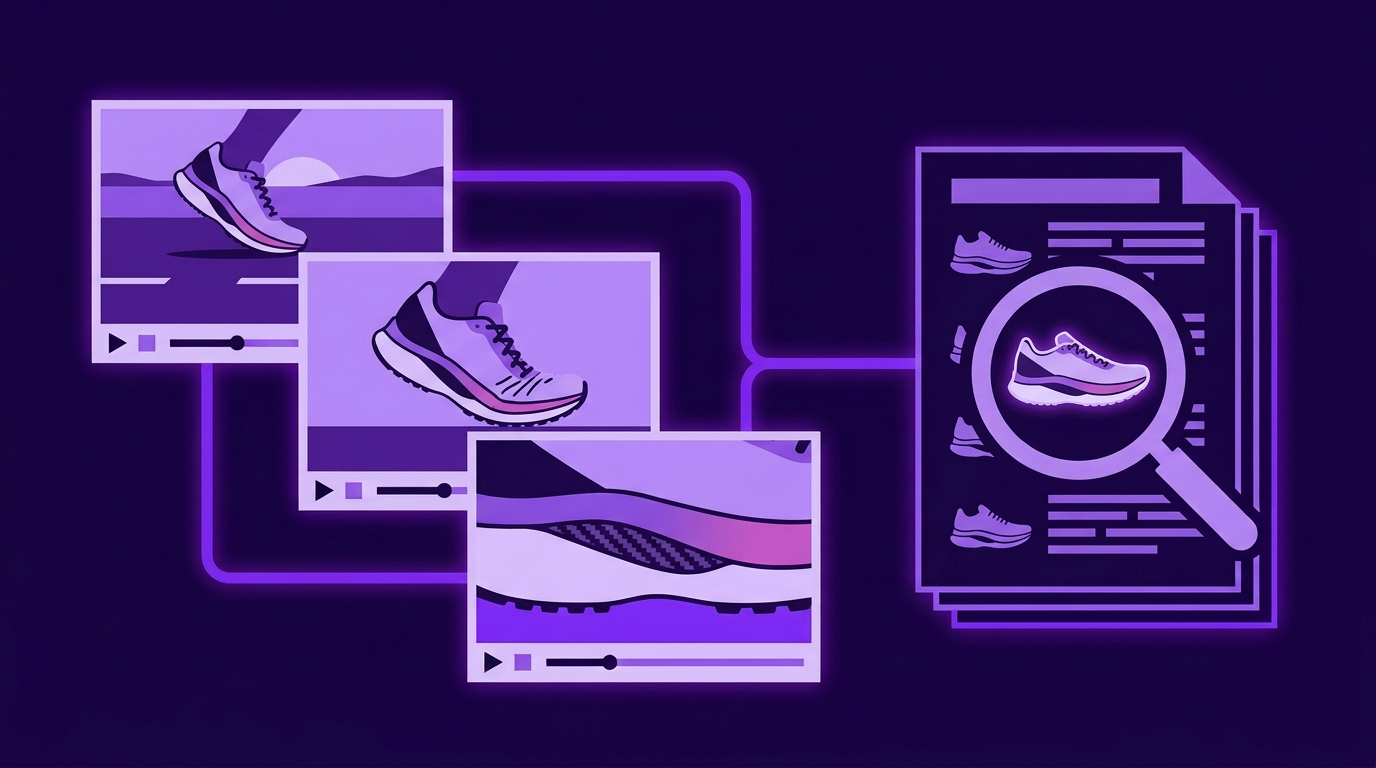
Take a running shoe campaign. The main film shows the shoe on a dawn road run. A demonstration shows the forefoot flexing under load. A short edit provides a clear view of the plate inside the midsole.
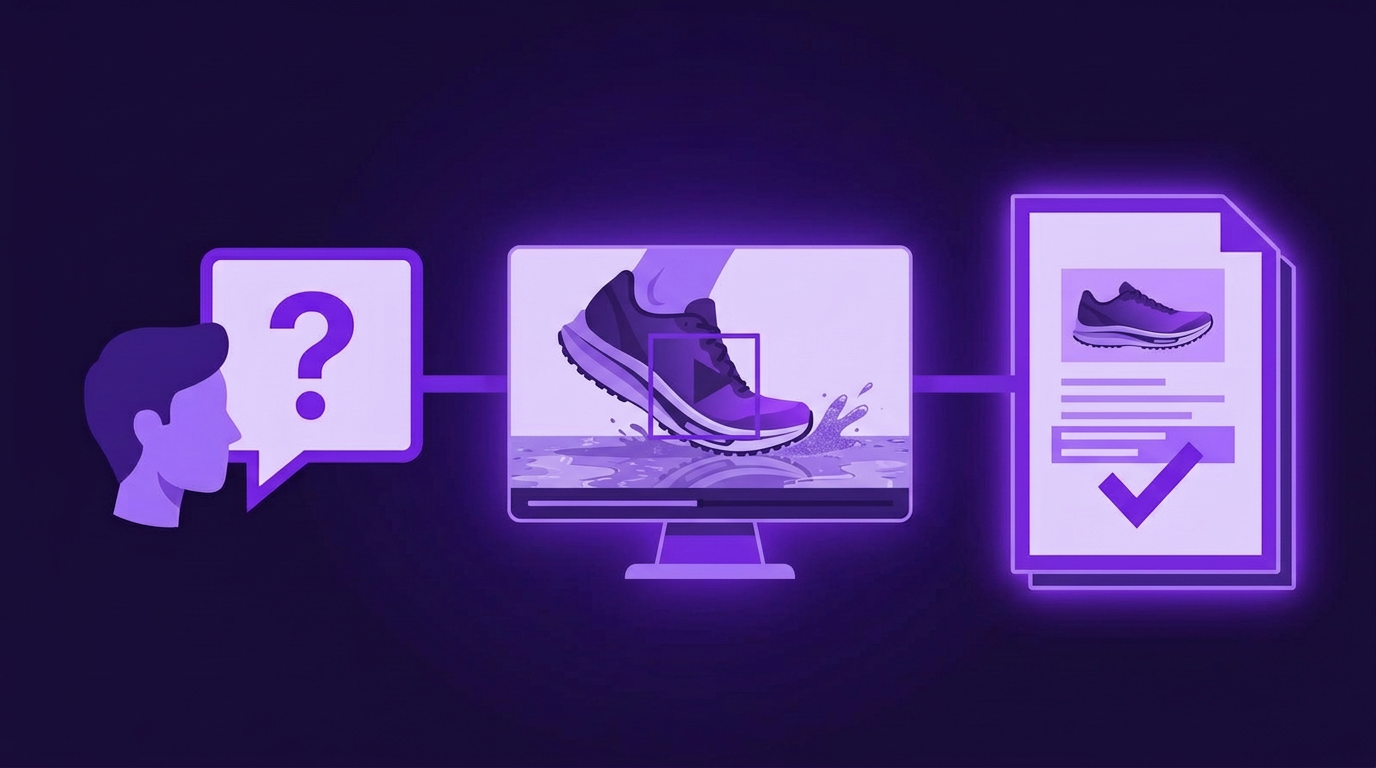
A customer asks which version the film shows. The demonstration supplies the sequence, while the close-up helps identify the component. Current approved product information can confirm the exact model and whether the plate is fitted as standard or reserved for the racing version.
The answer should preserve those relationships. Describe what the footage demonstrates and use the approved source for the product detail. Do not imply that one video establishes everything simply because the finished paragraph reads as a continuous explanation.
This is a practical reason to keep source references at the finding level. A reviewer can return to the right moment without playing every file. The aim is to make the evidence easier to inspect, rather than giving the entire team a compulsory matinee.
When should findings stay separate?
Separate findings when their scope differs or the relationship is uncertain. A feature shown on one vehicle trim should not become a statement about the whole range. A product available in one market may be absent from another. An older offer cannot supply a current price without confirmation.
The same principle applies to apparent contradictions. Check whether the records concern different versions before deciding that one is wrong. If the sources genuinely conflict, retain the uncertainty and ask the appropriate owner to resolve it.
Combining sources should improve the answer’s support. It should not conceal the conditions attached to each source. The person reading a polished explanation cannot recover qualifications that disappeared during synthesis.
Our article on turning video analysis into content you can trust covers the distinction between observations, approved facts and interpretation. It becomes particularly important when several assets contribute to the same output.
What does a useful evidence gap look like?
An evidence gap is specific enough to direct the next action. “We need more content” is vague. “We can show the plate in a midsole close-up, but cannot confirm which current models include it” identifies the missing information and the likely person who can supply it.
Review questions individually. One may be fully supported, another partly supported and a third outside the campaign’s scope. An atmospheric brand film may contribute valuable context without answering a technical specification question.
Keep a short record of the question, available sources, unresolved detail and next action. Use the available product functions where they help, or a clearly maintained review note where a manual step is needed. The value lies in knowing what to do next.
Gaps can also improve future briefs. If writers repeatedly need the same product detail, include the appropriate approved context in the next handover. Do not assume every missing answer requires another shoot; sometimes it requires the correct product sheet and a conversation.
How should you organise the collection?
Organise around a purpose people recognise, such as a campaign, launch or defined product question. Use names that help another colleague understand the boundary. “UK spring launch, current product range” provides considerably more guidance than “interesting videos”.
Keep market, version and product identity with each asset even when the collection has a shared name. A campaign may legitimately contain several variants, but the shared label should not erase their differences.
Avoid making the collection so broad that every answer becomes a sorting exercise. Start with a manageable campaign and add related material when its relevance is clear. Separate historical references from current source material where that distinction affects use.
The guide to organising a campaign collection and exploring its question coverage provides a practical starting process. A well-named collection is useful; one with an explicit purpose and checked sources is much more useful.
What should carry into the next content brief?
Pass forward the intended question, the relevant findings, their sources and the approved facts needed to complete the answer. Identify unresolved details and the destination being considered. That gives the writer a bounded task without requiring them to rediscover the campaign.
The output might be a product explanation, a YouTube description, a LinkedIn observation or a useful contribution to a relevant discussion. Several ads can inform one output, while the same checked finding can contribute to different formats.
Reuse the evidence with care. A description of a product demonstration and a discussion of the creative may draw on the same scene but make different claims. Review the final wording for each destination rather than treating an approved source as approval for every possible sentence.
The question-to-evidence guide shows how to begin with a specific customer need. That connection gives the collection a practical reason to exist beyond admirable housekeeping.
How can you tell whether the library is becoming useful?
Look for work that becomes easier or more dependable. Can another colleague find the supporting scene? Can a writer identify which fact still needs confirmation? Can the team reuse a checked explanation without repeating the full investigation?
Record the effort required and the corrections made across a few comparable tasks. If you want to claim time savings, measure the preparation and review work as well as the generation step. Leaving half the labour outside the stopwatch can produce an excellent result for the stopwatch.
Also examine what remains difficult. Confusing versions, incomplete product context and inaccessible sources are practical problems to fix. A larger collection will amplify those problems unless its organisation and review process improve with it.
The strongest outcome is a campaign resource that colleagues actually use: relevant findings, clear boundaries and a shorter route to a useful answer. More analysed material gives that process more to work with, provided its meaning remains connected to its source.
Put the whole campaign to work
Run your campaign’s ads through AdCyte and organise the resulting knowledge around questions your team needs to answer. Explore VideoGEO content generation or follow the collection guide to turn related assets into a working source for future content.
Frequently asked questions
Should we analyse every campaign version?
Yes. Main films, cutdowns and market versions can contribute different details or clearer views of the same information. Keep each version identifiable so its findings can be used accurately. Analysing broadly gives you more material; the purpose of each output determines what you use.
Can findings from different videos support one answer?
Yes, when their scope is compatible and each statement has appropriate support. Preserve the source behind the relevant findings and check additional product facts separately. Do not combine details from different models, markets or periods as though they describe one configuration.
What if the videos contradict each other?
Check product identity, version, market and date first. The difference may be legitimate. If a genuine conflict remains, retain it in the review record and ask the responsible owner to resolve it. Avoid smoothing the contradiction into a sentence unsupported by either source.
Does a collection need a large number of videos?
No. Begin with enough related material to support a useful investigation. A small campaign can demonstrate the method clearly. There is no editorial benefit in adding unrelated videos just to make the collection look substantial; relevance and source quality matter more than volume.
Can a brand film contribute without technical details?
Yes. It can supply narrative, setting, product presentation and campaign context for suitable writing. It may also help explain the creative approach. Use approved product information when a customer answer needs facts beyond the footage, and keep interpretations distinct from measured customer behaviour.
Does organising the library improve AI visibility automatically?
No. Internal organisation helps the team create and maintain useful public content. Discovery depends on publication and the external services involved. Evaluate library usefulness, publishing work and sampled AI observations separately so each reported outcome has the evidence it needs.