The Short Answer
Beauty brands can use VideoGEO to explain what their campaign demonstrations show while keeping application guidance, product identity and efficacy claims tied to the right sources. AdCyte helps teams review footage and create written material for product pages, campaign destinations and practical explanations. The useful answer identifies the product and shade, describes the visible sequence accurately and uses current approved references for instructions or claims the film cannot establish. It should help the customer understand the product without inventing results from the imagery.
Three key takeaways
- A demonstration can show an application sequence or visual appearance; it does not independently establish a measured or universal result.
- Product, shade, formula and market context matter, particularly when several items appear in one campaign.
- Use video evidence to answer specific customer questions and preserve approved qualifications close to the relevant statement.
What does a beauty demonstration explain particularly well?
Video can make an action easier to understand. A brush moves across the face, a balm is applied, a product is dispensed or a compact opens. The sequence can communicate texture, handling and visible appearance in a way that a short product label cannot.
Customers may still need additional information. Which shade appears? Is the applicator included? Are the directions shown complete? Does the film feature the same formula available in their market? These questions are often more useful starting points than a request for another article about a confident morning routine.
The campaign and the product record provide different parts of the answer. Reviewing them together helps the team explain the demonstration without assuming the camera has established everything a buyer might want to know.
The resulting content can be practical and engaging. It should give the reader something specific to understand, rather than expand a familiar adjective into several paragraphs of skincare-adjacent optimism.
Identify every relevant product in the sequence
Start with the product and shade mapping. A campaign may feature several items in quick succession, with similar packaging or different formulations across markets. An editor should not have to identify the product from the colour of a lid and a hopeful guess.
Use approved campaign context and current product references to confirm the item shown. Record the variant, shade and market where relevant. If the film uses a sample, prototype or previous pack, resolve that difference before preparing a current buying answer.
Keep accessories distinct from the product itself. A brush, sponge or other item visible in the demonstration may be a separate product. Do not imply that it is supplied in the box unless the authorised record establishes that.
This identity work is useful across the content programme. It supports clearer descriptions, more reliable product links and better review of any AI answer that appears to discuss the campaign.
Separate application, appearance and efficacy
A visible action, an on-camera appearance and a claim about a product's effect are different types of statement. Treat them separately in the source review.
| Statement | What the campaign may show | What needs another source |
|---|---|---|
| Application sequence | The order and actions visible in the edit | Complete authorised directions where the film omits steps |
| Depicted appearance | How the product appears in that footage | Any broader claim about consistent results |
| Product identity | Recognisable pack or supplied campaign mapping | Exact shade, formula and current market record |
| Efficacy or duration | A claim may be spoken or displayed | Approved wording, supporting evidence and conditions |
A polished before-and-after sequence should not become the writer's independent proof of a measured effect. Nor should a caption be converted into an action supposedly demonstrated by the film. Record what the source actually contains and review the additional claim on its proper basis.
This article describes an editorial method. Product instructions and efficacy statements should come from the brand's authorised sources and reviewers, rather than from a content team's interpretation of the scene.
Follow a tinted-balm campaign into useful content
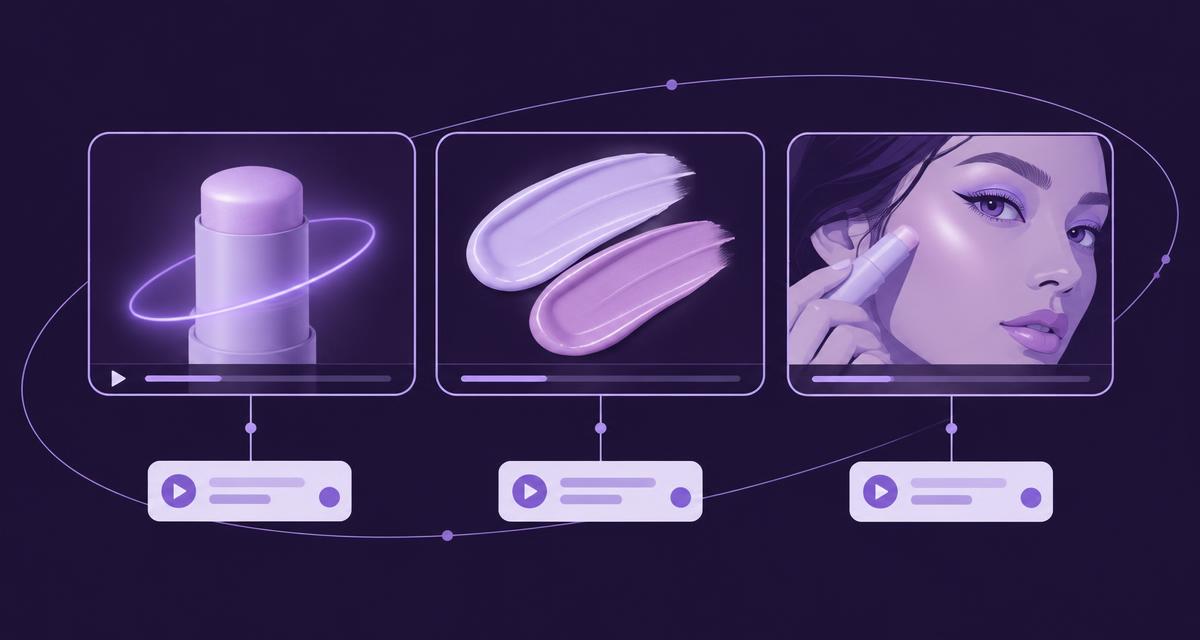
Imagine a campaign with a main brand film, an application cutdown and a short sequence showing several shades. Run all the ads through AdCyte and review the findings relevant to the customer's questions.
The application video may support a concise description of the visible action. The shade sequence may help identify which variant appears at a particular moment. The main film may supply campaign context and tone. Current product information establishes the exact names and any approved directions or claims needed for the answer.
A first output could clarify the shade shown beside the video. Another could explain the demonstrated application in language consistent with the approved instructions. A campaign description could connect the films to the collection's message.
These outputs should remain distinct. The campaign account does not need to become an instruction manual, and the practical answer does not need a poetic preamble before identifying the product. Customers looking for a shade name have already done quite enough interpretation.
Keep qualifications where they can do their job
When an approved claim has conditions, preserve them in the relevant answer. Do not move a material qualification to a distant footer merely because the opening looks cleaner without it. A standalone paragraph should not imply a broader result than the source supports.
Review shortened versions carefully. A video description, product-page section and social post may have different space constraints. If the necessary context will not fit, narrow the claim or choose another message rather than removing the condition that makes it accurate.
Clarity includes knowing where an answer stops. A useful explanation can state what the demonstration shows and direct readers to the current product information for the rest.
The guide to using approved facts in a draft provides the supporting review process. Keep the final wording connected to the correct product and market record.
Make the product page the first useful destination
Look at the page where someone will choose the item. Does it identify the shade in the campaign? Does it explain the demonstrated sequence where that helps? Are current directions and product details easy to reach?
Improve that destination before assuming the campaign needs several new articles. A clear section beside the video may answer the immediate question. A longer guide is worthwhile when it addresses a distinct task with adequate authorised information.
Keep links specific. A description of one shade should lead to the relevant item or a clear selection page, rather than leaving the customer to start again at the homepage. The destination owner should check the mobile experience and any variant selector that changes the visible product.
External versions can serve their own purposes, but they need their own review and maintenance record. Preparing a platform-specific draft does not establish an automatic publishing connection or a synchronised product feed.
Share review responsibilities without losing momentum
The campaign owner understands the intended creative. The product team confirms identity and authorised information. The appropriate claims reviewer checks statements requiring that expertise. The editor makes the answer clear, and the publishing owner verifies the live version.
Give those reviewers a compact record containing the question, selected source moments, product mapping, references and draft. Highlight the uncertain statements instead of expecting each person to discover the same gap independently.
Use AdCyte's available review and writing capabilities, with an explicit external record where needed. Do not assume that an approval in one workflow replaces the brand's established review requirements or authorises every later adaptation.
The campaign content-plan guide helps the team agree a small, coordinated set of outputs before generating a large volume of work.
What should the first pilot teach the team?
Choose a campaign with clear product mapping and accessible references. Select a few real questions about identification, application or the information shown in the film. Keep the scope small enough that the reviewers can inspect the sources properly.
Assess whether the published answers reduce ambiguity, preserve the approved wording and fit the customer's task. Record repeated corrections and the time required to resolve them. A missing shade mapping is a source problem; a generic introduction is an editorial one. They need different remedies.
If AI visibility observation is included, inspect whether the sampled response identifies the right product and retains relevant conditions. Keep those findings separate from measured customer behaviour or sales. The presence of a brand name alone does not establish a useful answer.
The opportunity is to make the campaign's existing information easier to understand and reuse. That can strengthen the public product story while giving the team a clearer record of what it is prepared to say.
Explore AdCyte for beauty and consumer goods, or book a demo with one demonstration and the questions your product team most often has to clarify.
FAQs
Can a demonstration prove that a beauty product works?
It can show the specific scene and actions recorded in the campaign. Use appropriate authorised evidence and approved wording for broader efficacy or duration claims. Do not treat the film alone as independent substantiation of a universal result.
Can AdCyte identify the shade automatically?
Analysis may provide useful observations, but confirm the exact shade through approved campaign or product information. Lighting, editing and similar packaging can make visual identification uncertain. Keep unresolved identities out of current buying answers.
Should we reproduce the video's application sequence as instructions?
Check it against the current authorised directions first. A short edit may omit steps or show only part of the process. Describe what is demonstrated accurately and use the proper reference for complete instructions.
Can one campaign support several formats?
Yes. Its evidence can inform a campaign description, product-page clarification or practical explanation with distinct purposes. Review each output for its destination and preserve the relevant product identity and qualifications.
What if the formula or packaging changes?
Review the affected video, copy and product mapping together. The film may need context or replacement for a current page. Use a destination register to identify external versions and verify updates individually.
What would make a useful first beauty-brand pilot?
Choose a small campaign with clear product and shade references, a responsive factual owner and several genuine customer questions. Test whether the team can publish clearer answers at a manageable review cost before expanding.