The Short Answer
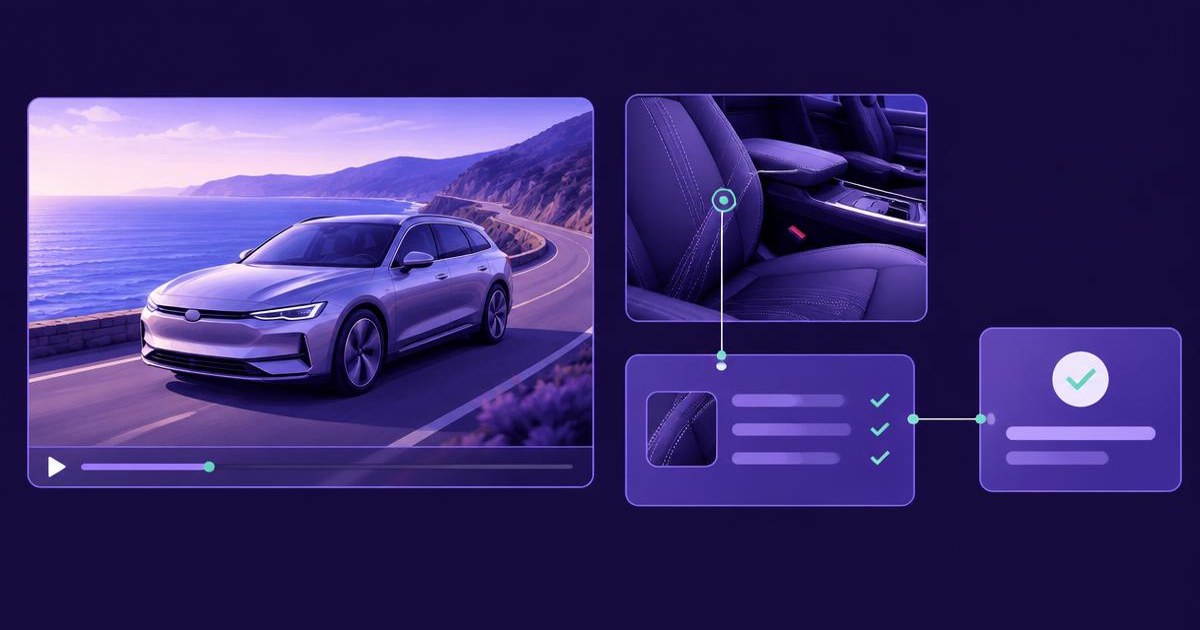
Automotive brands can use campaign films to identify the vehicles, features and experiences being presented, then connect that evidence with approved information for the correct model, trim and market. AdCyte helps recover those details and prepare useful descriptions, answers and content for review. The aim is to help people understand the car they have seen and the choices available to them. A coastal road can set the scene beautifully; it cannot, by itself, establish range, efficiency or what comes as standard.
Three key takeaways
- Match every campaign finding to the correct model, configuration and market before turning it into a buying answer.
- Use footage to explain what is shown, and approved references to establish specifications, options and qualifications.
- Give each published answer a clear owner and review trigger as model information and campaign availability change.
What does the customer need after seeing the film?
A vehicle campaign can create a strong impression while leaving practical questions unanswered. Which model appears? Are those seats part of the standard specification? Is the demonstrated feature available on the version sold in the viewer's market?
Those questions are a useful starting point for VideoGEO. The campaign has already introduced the product and made certain features memorable. The next task is to connect that interest with information precise enough to support a buying decision.
Begin with enquiries from customers, retailers and product teams, alongside relevant search research. Keep the origin of each question visible. A plausible editorial idea can be worth exploring, but it should not be presented as proven demand without supporting evidence.
The result may be a clearer model-page section, a feature explanation, a campaign description or a comparison between configurations. Choose the format after the question. An answer about which trim is shown rarely improves merely because someone has commissioned another thousand words.
Identify the vehicle before interpreting the story
Establish the model, model year where relevant, trim, options and market for each asset. Check whether the footage contains more than one configuration or includes a vehicle specification different from the linked destination.
Use the campaign brief and authorised product records alongside the video. Similar bodywork does not establish an identical specification. A familiar name can also persist across product updates, leaving the campaign library with several vehicles that look conveniently interchangeable in a thumbnail grid.
AdCyte's evidence review can help teams inspect the products, messages, claims and demonstrations found in the film. A person should resolve uncertain identity and connect findings to the appropriate references before writing a product-specific answer.
Keep the source asset and relevant moment attached to the finding. If a later reviewer asks why the copy identifies a particular interior, the team should be able to open the evidence and the supporting configuration record rather than reconstructing an afternoon's assumptions.
Separate the experience presented from the capability established
Campaigns often communicate an experience: comfortable travel, freedom, craftsmanship or a sense of occasion. Those messages are legitimate subjects for descriptive content. They should remain distinguishable from measurable claims about the vehicle.
| Campaign material | Useful explanation | Additional evidence needed |
|---|---|---|
| A long coastal driving sequence | The journey and touring theme presented | A quantified range or efficiency claim |
| Close-ups of interior stitching | The visible finish and campaign emphasis | The approved material and manufacturing description |
| A feature demonstration | The action shown in that configuration | Availability, operating conditions and limitations |
| Several trims in one edit | The range of vehicles appearing | Which feature belongs to which trim |
| A charging scene | The charging interaction depicted | Applicable charging specifications and conditions |
Review wording that moves too quickly from impression to proof. A quiet soundtrack does not establish a measured cabin-noise result. A comfortable-looking passenger does not settle every question about long-distance comfort, however convincing their knitwear.
The useful editorial habit is to ask what the sentence relies on. If the answer changes from the scene to an approved technical reference, make sure that reference actually supports the precise claim and configuration.
Turn one campaign into a coherent group of answers
Consider a Meridian GT launch campaign comprising a main film, an interior cutdown and a feature demonstration. The main film presents a city-to-coast journey. The interior edit focuses on finishing details. The demonstration shows one confirmed feature in use.
Run the full set through AdCyte so the team can inspect the distinct evidence. Then assign useful outputs rather than one article per asset. A campaign description could explain the story; an interior answer could connect the close-ups with approved material information; a feature guide could explain the demonstrated action within its documented limits.
The same sources may support more than one output, but each piece should answer a distinct question. Keep an unresolved configuration query in the review queue instead of reproducing it across several drafts.
A campaign library becomes more valuable when the team can see which questions are already supported and which need additional material. The campaign coverage guide provides a method for making those gaps visible without assuming that every question can be answered from the footage.
Make configuration comparisons genuinely useful
Customers may need help understanding the differences between versions. Start with the decision they face and identify the exact configurations being compared. Use consistent criteria and current authorised information.
Explain whether a feature is included, optional or unavailable for each relevant configuration. Avoid letting “available” drift into “included” as the copy moves from the source sheet to a polished summary. That single word can carry a surprising amount of disappointment.
Where specifications use different test conditions or definitions, preserve the qualification and avoid an unsupported direct verdict. A comparison can explain a difference without declaring a universal winner.
Our comparison article sets out the editorial test, and the comparison guide provides a working record. Both keep the recommendation connected to the buyer's needs and the actual evidence, rather than the hierarchy of the model range.
Put the answer beside the next useful action
Choose a destination that fits the question. A precise trim clarification may belong beside the campaign video on the model page. A fuller feature explanation may warrant a guide. A comparison may sit within an existing buying journey.
AdCyte can help prepare reviewed campaign knowledge for supported publication routes and external use. Confirm the actual destination and handoff for the project. Do not assume that content automatically reaches every dealer, configurator or regional website.
Give the publisher the exact approved copy, applicable configuration, source references and relevant review conditions. Inspect the result after publication, including mobile presentation, links and qualifications. A carefully reviewed sentence can lose its meaning if a template hides the qualifier several screens away.
Useful content should also be easy to navigate. Link the explanation to the relevant model information and related questions, while giving readers a clear route to current specifications or an appropriate human contact.
Keep campaign history and current buying information distinct
A launch film may remain useful after the configuration changes. Preserve its historical context while making current availability clear at the destination. Updating the buying information should not rewrite what the original campaign actually showed.
Assign review triggers such as a model update, option change or destination replacement. Record which outputs depend on the affected facts. The maintenance guide explains how to follow a confirmed change through drafts and published copies.
For AI visibility work, agree specific questions and inspect the sampled answers. Check whether the response refers to the correct model and configuration, and whether any citation supports the statement being made. A mention of the manufacturer is not automatically an accurate answer about the vehicle.
Use those observations to investigate gaps or ambiguous information. They do not, on their own, prove that publication changed an AI answer or influenced a sale.
Start with one buying question the campaign can help answer
Choose a current campaign, identify its configurations and select one consequential customer question. Review the evidence and references, prepare the answer and agree its destination and owner.
The first useful result might be modest: a clear explanation of the feature shown, with the correct availability qualification. That is a credible foundation for a wider programme because the team can inspect how the answer was made and maintain it when the facts change.
Explore AdCyte for automotive, technology and telecoms, or book a demo to discuss a campaign-to-answer workflow using your own approved vehicle information.
FAQs
Can AdCyte work with an existing automotive campaign library?
AdCyte can be used to analyse campaign videos and inspect their findings. Start with an agreed set and confirm the current ingestion route, source context and available workflow for the project. A useful pilot does not require publishing the whole library.
Can the footage tell us which features are standard?
Footage can show a feature being used, but standard or optional status should come from approved information for the exact configuration and market. Do not infer inclusion from appearance in a campaign.
Can we make performance claims from a driving sequence?
A driving sequence can support a description of what is shown. Quantified performance, range and efficiency claims need appropriate authorised evidence and relevant conditions beyond the creative scene.
Does every vehicle film need its own article?
No. Review the ads through AdCyte, then decide which useful answers they support. Several films may contribute to one guide, while a single demonstration may inform several distinct pieces of content.
Does AdCyte automatically update dealer websites?
Do not assume that capability. Confirm supported publishing destinations and any external handoff. Each destination needs an owner who can approve, publish and verify the current copy.
Can AI visibility monitoring prove increased vehicle sales?
Sampled answers can show observed mentions, recommendations or citations within the checks performed. They do not establish sales impact or prove that a particular publication caused a change in an answer.