
The Short Answer
Generative engine optimisation, usually shortened to GEO, is the work of making information easier for AI-powered search services to find, interpret and use accurately in their answers. For brands, that means publishing useful answers grounded in dependable product information, making those sources accessible and checking how the brand appears. Video advertising can supply valuable evidence for that work, provided someone turns the relevant details into clear, reviewed information.
Three key takeaways
- GEO begins with questions customers need answered and sources that can answer them properly.
- Advertising contains useful product information, but a scene, a spoken claim and an approved fact need different treatment.
- Publication, an AI citation and a commercial result are separate outcomes. Measure each on its own terms.
What does GEO actually involve?
A customer asks an AI service which kind of cordless cleaner would suit a small flat with limited storage. The resulting answer may explain the trade-offs, name products and link to sources. A brand would reasonably like its suitable product to be represented accurately. Preferably without the assistant inventing a spare bedroom in which to keep it.
GEO describes the work around that opportunity: understanding the question, providing information that helps resolve it and examining what appears in relevant answers. The term is also written as generative engine optimization. Its boundaries overlap with SEO, content strategy, product information and reputation, so a useful programme needs more substance than a new acronym on an old spreadsheet.
For a marketing team, the practical starting point is a question such as “Can this cleaner be stored without drilling into the wall?” The work then becomes concrete. Find the approved answer, inspect any demonstration, decide where the explanation belongs and make the public version useful enough to stand alone.
How can an AI answer connect with your content?
AI products differ, and their behaviour changes. In a search-enabled experience, a service can retrieve information from external sources while preparing an answer. Other responses may rely on existing model knowledge or supplied material. A brand cannot assume that every answer involves a fresh visit to its website.
This distinction changes the way you work. Updating a product page creates a better available source. It does not instantly update every model, remove older references or make every service choose that page. The source is within your control; the external answer is something to observe.
Google's guidance for its AI features says established SEO practices remain relevant and that no additional technical requirements apply to AI Overviews or AI Mode. That is a useful corrective to the idea that GEO requires a completely separate website or secret markup.
Our recommendation is to make each important explanation understandable on its own. Name the product, answer the actual question and preserve the conditions. A paragraph that says “it works brilliantly for this” asks the reader to reconstruct both the product and the task. Clear nouns earn their keep.
Where does video advertising enter the picture?
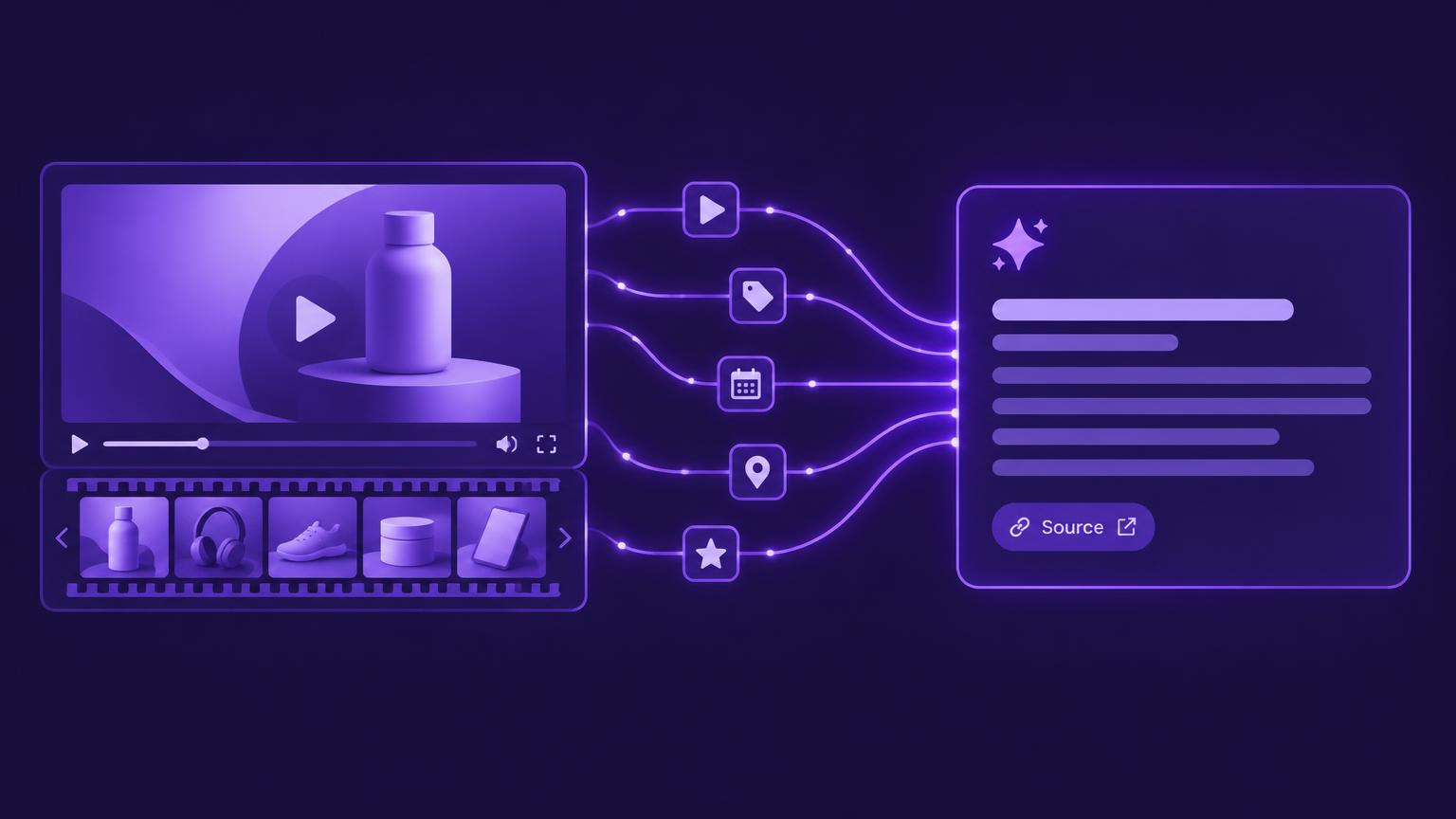
Advertising often contains information that the rest of the website barely explains. A product is shown folding, fitting, opening or connecting. On-screen text identifies a variant. A demonstration makes a feature comprehensible in a few seconds. The customer question may be answered visually, even when nobody says the words.
That is a useful starting point for VideoGEO: turning information from video into reviewed, publishable knowledge. AdCyte analyses campaign material, connects useful findings with their supporting moments and helps teams develop written outputs from that evidence and supplied context.
The film remains valuable. So does its transcript. But a transcript may omit the fold-away handle, the included attachment or the qualifier printed at the bottom of the screen. Those omissions matter if the resulting answer is supposed to help someone choose a product.
It is equally important to recognise what the footage cannot establish. Showing a cleaner under one sofa does not prove it fits under every sofa. Showing a cola can at a picnic does not establish its ingredients. The creative department has demonstrated a scene, not rewritten the laws of evidence.
A campaign example: from an attractive film to a useful answer
Imagine a launch campaign for a compact cordless cleaner. One advert shows the cleaner being stored upright in a narrow cupboard. Another demonstrates the detachable handheld unit. A short edit focuses on the charging dock, with small-print conditions about installation.
Together, those ads suggest several customer questions. Can the cleaner stand independently? What needs fixing to the wall? Which parts detach? Does the version shown include the dock? Each deserves a specific answer rather than one enthusiastic paragraph about convenience.
| Campaign material | Useful question | Further evidence needed |
|---|---|---|
| Cleaner standing in a cupboard | How can I store it? | Approved storage instructions and dimensions |
| Handheld unit being detached | Can I use it for smaller cleaning tasks? | Exact model, included attachments and permitted uses |
| Charging dock in the final frame | Does charging require installation? | Current installation guidance and configuration |
| Fast montage of several tasks | Which uses does this model support? | Clear distinction between demonstrated tasks and broader claims |
The resulting page might explain storage options, show the relevant video and link to the current manual. It could also identify where a separate accessory changes the answer. That is useful to someone who has never seen the campaign and useful to a reviewer checking the wording.
Start with the customer's decision
A broad term such as “best cordless cleaner” is tempting because it sounds commercially important. It also conceals a collection of different needs: stairs, pet hair, storage, weight, noise and budget. A brand's content becomes more useful when it addresses the questions it can genuinely resolve.
Collect these questions from search data where available, product enquiries, customer-support conversations and the campaign brief. Keep the origin visible. A query found in Search Console, a recurring sales question and a question suggested by a writer are all usable inputs, but they are different kinds of evidence.
Then ask which questions the campaign and approved references can support. If the answer is missing, commission a source check or a better explanation. Do not ask a writing tool to fill the silence with confidence. That particular service is already rather well supplied.
Publish where the answer belongs
An important product question may belong on the product page. A more complex decision may deserve a guide. A campaign overview can sit alongside the advert, while a short answer may improve an existing FAQ. The format should follow the reader's task and the evidence available.
Running every advert through AdCyte helps reveal differences across edits and demonstrations. It does not require a separate public article for each file. Several ads can support one clear answer; one substantial demonstration can support several genuinely different explanations.
Connect the published material to the relevant product and campaign pages. Give readers a route to current specifications, purchase information or a practical next step. A useful resource should not become a beautifully written cul-de-sac.
What should you measure?
Start by recording what your team actually changed: the question addressed, evidence reviewed, page published and date. Then examine discovery and outcomes using the data you genuinely have. The measurement explainer separates several signals that are often squeezed into one convenient number.
A brand mention tells you the name appeared in a sampled answer. A recommendation describes a different kind of representation. A citation links to a source. A referral records a visit where attribution is available. None automatically proves the next, and a citation does not certify every statement around it.
Use a repeatable question set with recorded providers, dates and relevant conditions. Retain failures separately and inspect the actual answers. If a result improves after publication, record the sequence without claiming that one page caused the change. That restraint makes the findings more useful to the next person making a decision.
Who should own GEO in a brand team?
The programme needs a named owner, but the work crosses familiar boundaries. Search specialists understand discovery questions and technical access. Product owners establish facts. Campaign teams know the creative context. Content teams turn those inputs into useful public explanations.
For video-heavy brands, the missing connection is often the handover between campaign production and written product information. Agree that connection before buying another reporting dashboard. A dashboard can reveal a gap; somebody still has to decide what belongs in it.
Start with one campaign and a defined group of customer questions. Establish the current sources, review the available video evidence and improve the most useful destination. That gives the team a repeatable process and a practical way to learn whether its assumptions were sensible.
Bring your advertising into the plan
Use the GEO content brief guide to turn customer questions into a defined piece of work. If you want to see how campaign evidence becomes written content, explore AdCyte's content-generation workflow.
FAQs
Does GEO replace SEO?
No. Accessible pages, useful content and clear site organisation remain relevant. GEO adds an explicit focus on how information is represented in generated answers, while SEO continues to address search discovery more broadly.
Is GEO the same as paying to appear in an AI answer?
No. This article concerns improving available information and observing organic representation. Advertising placements and paid partnerships are separate arrangements and should be described as such.
Can AI systems understand video without a written version?
Some systems can interpret video, but capabilities and retrieval experiences vary. A reviewed written explanation gives the campaign another useful public form and helps people inspect the meaning without relying on one viewing experience.
Should every advert be analysed?
Yes, include the relevant campaign ads and edits so important differences can be found. Then choose useful public outputs based on customer questions, rather than automatically creating one article for every uploaded file.
Can GEO guarantee a citation or recommendation?
No. You can improve and publish a source, but external services decide which material to retrieve and use. Record observed results without promising control over future answers.
What is a sensible first project?
Choose a current campaign, a small group of genuine customer questions and an owner for the product facts. Build reviewed answers, publish where appropriate and document what you observe afterwards.
Where to go next
- Build a GEO content brief: turn the category explanation into a practical assignment.
- Bring video campaigns into your brand's GEO strategy: see how the teams divide the work.
- How SEO, GEO and VideoGEO work together: explore the relationship between the disciplines in more detail.