
The Short Answer
Marketing leaders should ask which customer questions the programme will answer, which campaign evidence and approved facts will support it, who will maintain the outputs and what decision the first pilot should inform. VideoGEO can extend the usefulness of existing video investment, but its value should be demonstrated through reviewed work and carefully scoped observations. Fund a bounded first use case, make ownership explicit and assess the quality and cost of the workflow before expanding it across the organisation.
Three key takeaways
- Start with a useful business question and a contained campaign, rather than an organisation-wide promise of AI visibility.
- Budget for source review, factual approval, publication and maintenance alongside analysis and writing.
- Decide in advance what evidence would justify expansion, a revised approach or a pause.
What problem are we actually buying a solution to?
A new category can attract several different expectations at once. One team wants more content from campaign assets. Another wants clearer product information. A third wants to understand how the brand appears in AI answers. All can be reasonable objectives, but they need different work and different evidence of success.
Ask the sponsor to name the immediate problem. Perhaps campaign knowledge is difficult to reuse after launch. Perhaps product answers are incomplete despite substantial video investment. Perhaps leadership sees occasional AI responses and wants a more inspectable observation process.
Then connect the proposed work to that problem. VideoGEO should produce an intelligible chain from the campaign evidence to a reviewed output, a destination and a next decision. If the proposal moves directly from “AI is important” to a large annual content target, several useful questions have gone missing in transit.
The strongest starting brief is usually narrow enough that a team can demonstrate the work with real material. Broad ambition can follow once the operating model has earned it.
Which existing investment could work harder?
Brands have already paid for creative development, production and campaign delivery. The films may contain demonstrations, product introductions and messages that remain useful after the media schedule ends. Recovering that information can create additional value from work already funded.
That does not make the extension free. People still need to review findings, confirm current facts, shape the output and maintain the public version. Ask for those activities to be visible in the pilot estimate rather than hidden beneath a claim that the content is already there.
Choose a campaign where the sources are available and the organisation has a clear reason to improve an answer. A current product launch with a responsive product owner is often more instructive than a large historic archive whose reference material has disappeared into a former colleague's inbox.
The campaign-library article explains the wider opportunity. For an investment decision, the first question is which bounded piece of that opportunity can be tested responsibly.
What should the pilot be expected to deliver?
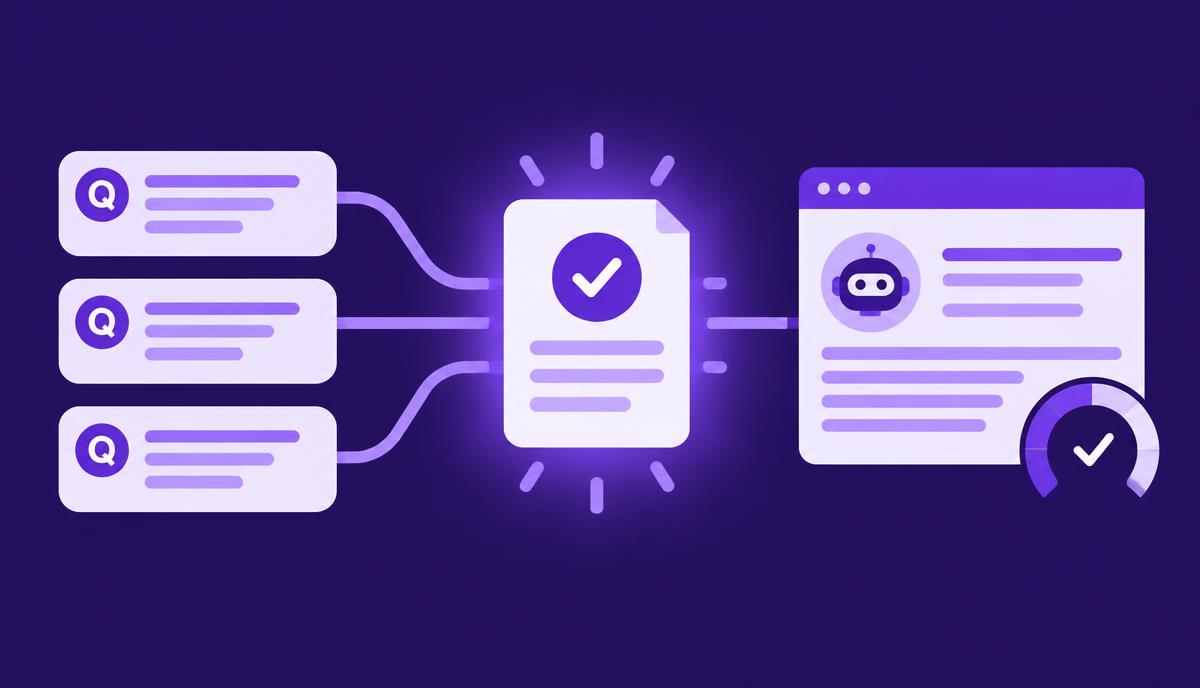
A useful pilot should deliver more than generated copy. Ask for a reviewed evidence record, a small set of useful answers, actual publication outcomes and a candid account of the effort and unresolved questions.
Where AI visibility observation is included, require the actual sampled answers and a description of the method. The team should distinguish mentions, recommendations and citations, report failed checks separately and explain whether the observations came from an API or another supported surface.
| Investment question | Useful pilot evidence | Weak substitute |
|---|---|---|
| Can we recover useful campaign knowledge? | Reviewed findings connected to source moments | A large unreviewed analysis export |
| Can we publish information customers need? | Approved answers at checked destinations | A count of drafts generated |
| Can the team sustain the workflow? | Actual effort, owners and repeated correction causes | An assumed time-saving percentage |
| Are we learning about AI representation? | Inspectable samples with questions and methods | An unexplained headline score |
| Should we expand? | A decision against agreed criteria | Enthusiasm about a new category |
The table gives a leadership review something concrete to discuss. It also protects a good pilot from being judged against promises it never made.
Who owns the facts and the final publication?
An investment case needs an operating model, even a small one. The campaign team understands the creative. Product owners know which facts are current. Content specialists shape the explanation. The destination owner controls the public page. Someone must connect those contributions and resolve gaps.
AdCyte supports the route from video analysis to reviewed written material and supported publication or visibility workflows. It should not be assumed to take over the authority of the brand's product, claims or publishing owners.
Ask what happens when a finding is ambiguous, two references disagree or a product fact changes. The answer should identify a decision-maker and a practical next step. “The AI will handle it” is rarely an adequate entry in a responsibility matrix, despite its impressive ability to shorten the meeting.
Keep the first workflow proportionate. A named owner and a clear record may be enough for a bounded pilot. More complex portfolios may need stronger governance, but the team should demonstrate the need and verify the available controls before promising an enterprise rollout.
How should we think about cost?
Consider the whole cost of creating and maintaining useful outputs. Include software usage, source preparation, review, factual clarification, publishing and later corrections. Use current commercial information for AdCyte plans and usage rather than assumptions from an old demonstration.
Compare the pilot with the actual alternative. Would the team otherwise write the answer manually, leave the question unanswered or reconstruct the campaign evidence for each new request? Those alternatives have different costs and consequences.
Record effort by cause. Time spent resolving an outdated product record is different from time spent improving a weak draft. A process may reveal a pre-existing information problem rather than create one. That finding can be valuable, but it should not be presented as a software efficiency gain.
Scale the useful workflow, including its review responsibilities. Increasing generation volume before understanding approval and maintenance capacity can create a content backlog with very agreeable grammar.
What would justify expanding the programme?
Agree the criteria before reviewing the results. Useful criteria might include answering a defined set of priority questions, publishing accurate material, demonstrating manageable review effort and assigning a credible maintenance owner. Choose thresholds that fit the organisation rather than borrowing an unsupported industry benchmark.
Also decide which findings would change the approach. If source facts are incomplete, invest in resolving them before broadening the content plan. If a particular output consistently adds little value, remove it. If one team has a repeatable process, consider extending that pattern to a related campaign before jumping to every brand and market.
Discovery observations can inform the decision, but they should not be the only test of value. A useful product explanation may improve the customer journey while AI citation evidence remains uncertain. Conversely, a cited page may still be inaccurate or costly to maintain.
The pilot guide provides a record for this decision, and the progress-review guide helps select the next actions.
What should leaders be careful not to infer?
A mention in an AI answer does not establish a recommendation. A citation does not establish a visit. A visit does not establish a sale. Changes after publication may be worth investigating, but timing alone cannot prove that the publication caused them.
Likewise, a successful demonstration in one workspace does not establish that every proposed feature or workflow is available across every plan. Ask for the actual product scope and the required manual steps. A clear boundary is a sign that the team understands the implementation.
The objective is not to make the programme timid. It is to make its progress inspectable. Leaders can fund a promising new area without asking the evidence to perform a more ambitious role than it can support.
What should the first leadership brief contain?
Keep it to the problem, campaign scope, priority questions, sources, outputs, owners, expected effort and decision criteria. Add the observation method if AI visibility is included. State which dependencies need resolving before the pilot can begin.
That brief gives the team room to work while preserving a clear review point. It also makes the next investment decision easier: extend what proved useful, fix what caused avoidable friction and stop work that did not earn its place.
Explore AdCyte for marketing and GTM leaders, or book a demo around the campaign and decision your team wants to test.
FAQs
Should VideoGEO sit within the SEO budget?
It can, but the right budget owner depends on the initial objective and organisation. Campaign reuse, content operations and AI visibility may involve several teams. Give the programme one accountable owner and make each team's contribution explicit.
What is a reasonable return to expect from a pilot?
Start with useful, reviewable outputs and evidence about the effort required to produce them. Commercial return needs the organisation's own measurement and a suitable method. Avoid promising revenue or ROAS from content generation or sampled citations alone.
Do we need to analyse the entire archive first?
No. Choose a coherent campaign and establish the workflow with its relevant ads. Use the findings to plan broader analysis. An archive-wide project should follow a clear purpose and ownership model rather than become a prerequisite for the first useful answer.
What should a supplier demonstration show?
Ask to follow a real source from video finding through review and written output to the available publishing or observation workflow. Inspect the supporting evidence and manual steps. Confirm current product availability and plan requirements separately.
Can we scale content production before visibility improves?
Yes, if the content is useful, accurate and maintainable and the workflow meets the agreed decision criteria. Keep discovery observations separate and continue learning. Do not scale purely to increase output counts or because a citation outcome is expected.
What is the most useful first question for a leadership team?
Ask: “Which important customer question could we answer better using the campaign evidence we already own?” That connects the investment to a tangible improvement and gives the pilot a practical starting point.