
The Short Answer
Answer engine optimisation, or AEO, is the practice of making information useful for services that return answers to questions. GEO focuses on visibility and representation in generated answers, so the two terms overlap considerably. For advertisers, the practical work starts with a customer question, a supported answer and a suitable public source. Video campaigns can supply evidence, examples and demonstrations that make those answers more useful.
Three key takeaways
- AEO and GEO describe overlapping work; their names do not establish two completely separate technical systems.
- A good answer contains enough context to be accurate when read on its own, including relevant product and market conditions.
- Video advertising becomes more useful when its demonstrations and claims inform reviewed answers, FAQs and product explanations.
Why are there so many names for this work?
Marketing has never suffered from a shortage of initials. SEO, AEO, GEO and VideoGEO now appear in proposals that sometimes describe much the same task: help people find useful information and understand the product correctly.
AEO puts the emphasis on the answer. The term is commonly used for work involving direct answers in search and assistants, including question-led content. GEO puts the emphasis on generative systems and the way they construct and present a response. Definitions vary between practitioners, so it is worth asking what a service actually includes.
For a brand, the naming debate becomes useful only when it clarifies responsibility. Who establishes the facts? Who decides which questions matter? Where will the answer appear? Who checks whether it remains accurate? If those questions are missing, the proposal may have an excellent acronym and very little underneath it.
A working distinction between SEO, AEO and GEO
We use the following distinctions to organise the work, rather than as an industry standard. They help explain which aspect of a project is being discussed without pretending that each discipline lives in a sealed compartment.
| Term | Main emphasis in this article | Example task for an advertiser |
|---|---|---|
| SEO | Discovery through search | Make the relevant product and campaign pages accessible and useful |
| AEO | Clear answers to specific questions | Explain how a demonstrated feature works, with necessary conditions |
| GEO | Representation in generated answers | Inspect how a product is described in sampled AI responses |
| VideoGEO | Reviewed knowledge from video advertising | Turn visual, spoken and on-screen evidence into useful written content |
A single product FAQ may contribute to several of these activities. The person asking whether a refill fits the current bottle will not care which internal budget paid for the answer. They will care if the answer describes a discontinued bottle and leaves them holding the wrong refill.
The existing SEO, GEO and VideoGEO explainer looks more closely at how the disciplines work together. Here, the focus is on what makes an answer genuinely fit for use.
What makes an answer useful?
A useful answer resolves the question at the appropriate level of detail. It identifies the subject, explains the relevant fact or process and includes any condition that changes the meaning. It also gives the reader a way to inspect or act on the information.
Consider “Can I refill this bottle?” An answer beginning “Yes, our sustainable design makes it easy” sounds agreeable but leaves several important details missing. Which bottle? Which refill? Does the pump need to be removed? Is the refill sold in the reader's market?
A better answer names the current bottle and compatible refill, explains the basic sequence and links to the appropriate instructions. If the video shows the process, use that demonstration to make the explanation clearer. A short answer can lead, while the detail sits immediately below it.
Conciseness is useful only while the meaning survives. Removing every qualification may make a sentence easier to quote, but it can also make it wrong. The aim is a clear answer that still deserves to be repeated.
Why advertising is a useful source of questions
Campaigns are built around things the brand wants people to notice. Product demonstrations show a process, launch films establish a story and comparison scenes highlight a difference. Those creative decisions often point directly to the questions a customer will ask next.
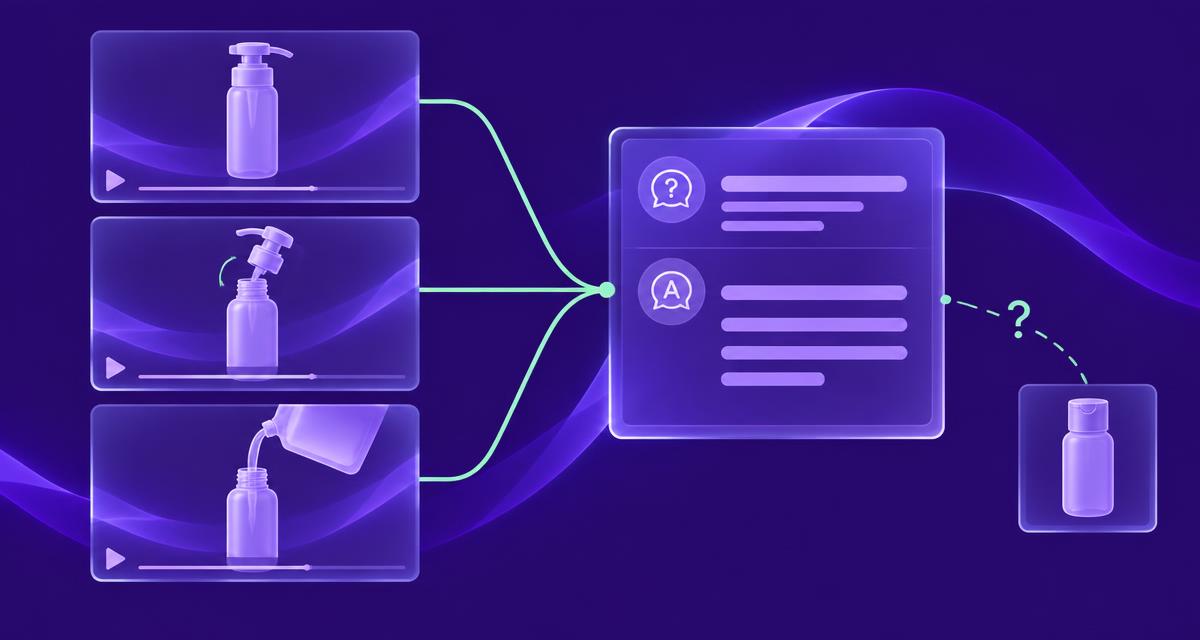
A beauty advert shows a refill being poured into a bottle. A technology campaign shows a phone connecting to another device. A cola advert introduces a new variant through pack design and on-screen wording. Each can prompt useful questions about compatibility, operation or the difference between products.
Review the full campaign, including short edits. A detail absent from one version may be visible in another. Equally, an edit made for a different market may carry a condition that should not be applied elsewhere. The evidence needs its context before it becomes a general answer.
AdCyte helps teams identify those details and connect them with the supporting video moments. Approved references then fill the gaps that the creative was never designed to explain. Thirty seconds can do a great deal, but it is an ambitious place to hide an entire instruction manual.
From a refill demonstration to a dependable FAQ
Imagine three adverts for the same personal-care range. The first introduces the product. The second shows a refill sequence. The third features a travel-size bottle. A writer asked to create an FAQ from “the campaign” could easily assume that all bottles are refillable.
The better approach is to identify the product shown in each film and compare that with the current approved information. If the refill applies only to the full-size bottle, the answer should say so. The travel-size advert may support a different question and should remain separate.
| Question | What the video contributes | What the reviewer must confirm |
|---|---|---|
| How do I refill the bottle? | Visible sequence and handling | Current instructions and applicable bottle |
| Does the refill work with the travel size? | Product identity, if visible | Explicit compatibility reference |
| What comes in the pack? | Items shown in the creative | Current market-specific pack contents |
| Is this the new version? | Names, packaging and campaign context | Approved version and availability information |
This work produces a more useful FAQ and a clearer record of what the brand actually knows. It can also reveal that a proposed answer needs a source check rather than another paragraph.
Does AEO mean writing everything as a question?
Question headings help when the reader arrives with a recognisable question. They are less useful when they force a complex subject into a contrived interview with itself. A process may need numbered steps; a specification may need a table; a buying decision may need a comparison.
Our preference is to put a direct answer near the beginning, then develop the explanation. For a substantial article, that means showing the reasoning and evidence. For an FAQ, it means keeping the answer focused while linking to the fuller source where necessary.
There is no useful reason to pad a straightforward answer to an arbitrary length. There is also no prize for compressing a safety-critical or compatibility-sensitive explanation into a slogan. Choose the format that lets the customer understand the decision correctly.
Where should the answers live?
Start with the page a customer would reasonably expect to answer the question. Compatibility details may belong on a product page. A demonstration sequence may deserve a practical guide. A campaign page can connect the advert with the relevant explanations.
Avoid building a giant FAQ that duplicates every product page and becomes impossible to maintain. A small, well-scoped group of answers is easier to review and more useful to navigate. Link related questions where the reader genuinely needs the connection.
Use public destinations that the team can keep current. AdCyte can support written content preparation and supported publication routes, while other channels may use the established manual process. A clear ownership record matters more than publishing the same answer in six places and remembering only four of them.
What can you reasonably expect to improve?
The most immediate result is better information: clearer answers, fewer unsupported statements and a more consistent connection between campaign evidence and product facts. These are outcomes the team can inspect directly.
Search discovery, AI representation and commercial effects need their own observations. An answer may be useful without being cited in a particular sample. A citation may appear without a recommendation. A visit may arrive without a conversion. Keep those distinctions when deciding whether the work deserves further investment.
The strongest starting point is a real customer question that the brand can answer better than it currently does. Review the campaign, build the explanation and give it a sensible destination. That is a practical AEO project whether the next meeting calls it GEO, content optimisation or simply fixing the product page.
Turn the campaign into useful answers
Follow the product FAQ guide to build a reviewed answer set from several adverts. To see how video findings become written drafts, explore AdCyte's content-generation workflow.
FAQs
Is AEO a replacement for GEO?
The terms overlap, and usage varies. AEO emphasises answering questions; GEO emphasises generated answers and representation within them. Define the work and expected outputs before treating the labels as separate services.
Do all answers need an FAQ page?
No. A product section, practical guide, comparison table or campaign explanation may be a better home. Use an FAQ when a focused set of related questions helps the reader.
Can a video transcript provide the answers?
It can supply spoken information, but it may miss visual demonstrations, on-screen conditions and product details. Review the video and approved references before relying on the transcript alone.
Should we use the exact words people search for?
Use recognisable language naturally and preserve the meaning of the question. You do not need to repeat an awkward phrase throughout the page or create separate answers for every minor wording variation.
Can an answer be short and still trustworthy?
Yes. State the answer clearly and keep essential qualifications nearby. Link to fuller instructions or evidence when the task needs more detail than the short answer should carry.
Does a well-written FAQ guarantee AI visibility?
No. It improves the information available to readers and external services. Visibility depends on the service and situation, so examine actual observations rather than treating the format as a guarantee.