
The Short Answer
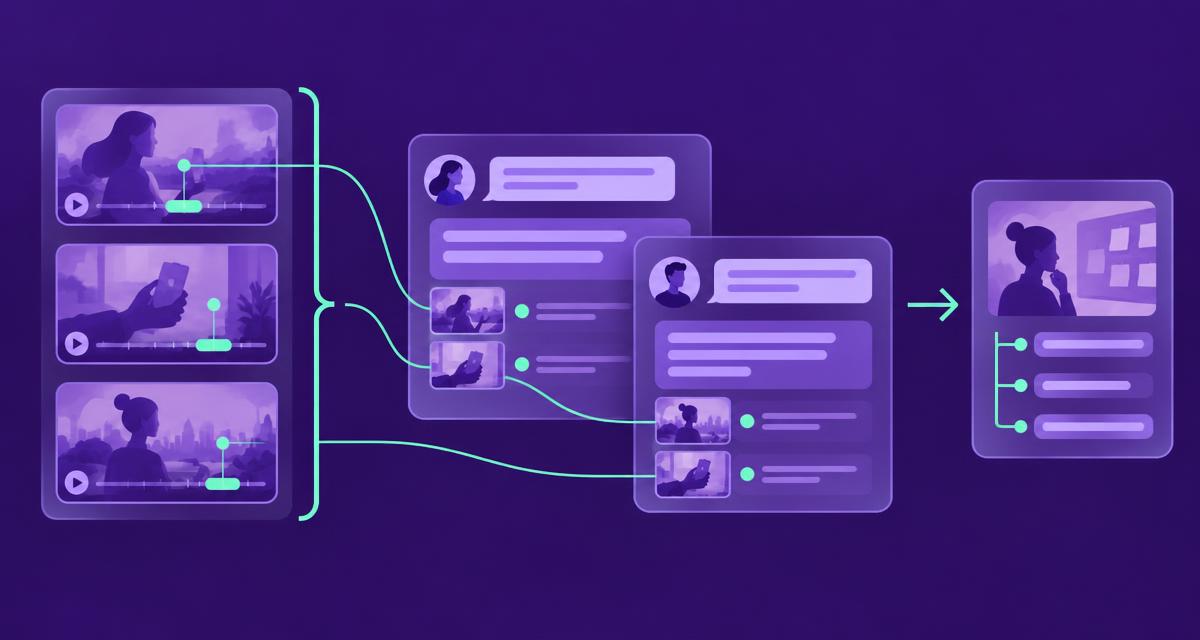
AdCyte's agents help you investigate what your video advertising communicates, which questions the evidence can support and what saved content already exists. Use VideoGeo Agent for accessible workspace material or Campaign Agent for a focused campaign conversation. Inspect the sources, identify gaps and take the findings into the appropriate writing and review workflow. The agents investigate and recommend; they do not change or publish business content.
Three key takeaways
- Choose a scope and a business decision before asking for an answer.
- Separate demonstrated actions, campaign messages and approved product facts.
- Check existing writing and evidence before deciding what to create next.
What you will achieve
By following this guide, you will turn a campaign question into an inspected finding and a practical next step. That might be reusing an existing explanation, improving a brief or requesting a missing fact. A useful investigation does not have to end with another article.
The workflow is straightforward: choose the material, ask a purposeful question, inspect the answer's sources, refine the investigation and decide what should happen next. The human decision remains important, particularly when the answer connects creative interpretation with factual product information.
Before you start
Use a workspace where the relevant agent is enabled and where you can access the campaign records you intend to investigate. Have the relevant saved analysis, reference facts and writing available where possible. Missing or inaccessible information limits what an answer can establish.
Agree the decision you are trying to make. “Prepare a more useful product explanation from these two ads” gives the investigation a direction. “Tell me everything” may generate plenty of reading without improving anyone's afternoon.
Availability depends on the current workspace and access. The steps below describe the workflow without assuming every account has the same controls or allowances.
1. Choose the scope that matches the decision
VideoGeo Agent and Campaign Agent are two entry points to the same underlying service. The difference is the material you bring into the conversation, rather than a choice between two unrelated kinds of intelligence.
| Entry point | Useful starting scope | Typical decision |
|---|---|---|
| VideoGeo Agent | Accessible workspace material, selected campaigns or selected videos | Find reusable writing or investigate themes across a selection |
| Campaign Agent | The campaign under discussion | Understand its messages, supporting evidence and next content needs |
Use a focused campaign scope when the question concerns one launch. Broader selection can help with reuse or comparison, provided each relevant campaign has evidence available. A wider scope does not make missing sources appear.
Where brand or market filters are available, their usefulness depends on explicit saved information. Do not assume an unlabelled video has been reliably assigned to the right market. Check the selection before interpreting the answer.
Check: you can name the material the question concerns and identify any expected sources that are absent.
2. Start with a professional question
Ask about something that would change a brief, a review or a publishing decision. These six questions offer useful starting points, with different purposes.
| Example question | What it helps you decide |
|---|---|
| What is this campaign communicating beyond the product name? | Which creative themes deserve explanation |
| Which claims have direct video support, and which depend on supplied facts? | What wording needs further review |
| Which useful customer questions can these ads answer? | Which audience needs the evidence can address |
| How does the message differ between these selected campaigns? | Whether the creative emphasis changes |
| Which existing approved deliverables could we reuse, and which need another review? | Whether new writing is necessary |
| What three content briefs should we consider next, and what evidence would each need? | Which assignments are worth preparing |
Adapt the wording to the material actually available. A question about approved deliverables is useful only if the relevant records and statuses can be inspected. Ask the agent to distinguish missing information from a confirmed absence.
For a first investigation, choose one question rather than combining all six. The objective is a useful conversation, not a procurement questionnaire disguised as a prompt.
3. Read the answer by type of statement
A campaign answer can contain several kinds of information. Treat them differently when deciding what may become public copy.
An observed action describes something visible in the film. A spoken claim records what the advert says. On-screen wording may add a qualification or instruction. Supplied context can explain the campaign, while an approved reference may establish a product fact beyond the footage. Creative interpretation connects these elements into a reading of the message.
Those categories can coexist without being interchangeable. A caption saying “steep for four minutes” establishes an instruction in the advert. It does not establish that four minutes of steeping are shown. A product appearing in a film does not establish ownership of that film.
Likewise, a character enjoying a drink may contribute to the creative message without proving a health benefit. An atmospheric break scene can suggest relaxation without proving that the product caused it. The soundtrack is allowed to be persuasive; the specification sheet needs a different standard.
Check: you can distinguish what the answer observes, what it quotes and what it interprets.
4. Inspect the supporting sources
Follow the available source references and relevant moments. Check that the source concerns the right product, asset version and campaign context. Read or watch enough surrounding material to understand any qualification.
The presence of a source reference is a starting point for review. It is not a universal guarantee that every sentence in the answer has been proved. A source may support an observed feature while leaving a broader claim about performance unresolved.
If the source is incomplete, inaccessible or ambiguous, retain that limitation. Lack of retrieved support does not prove a claim is false. It tells you what this investigation has established from the accessible material.
Source inspection and reopening an existing answer do not use another Ask. Submitting a new question, including a follow-up, uses an Ask under the applicable allowance. Check the current workspace information rather than assuming unlimited questioning.
Check: the finding you intend to use has an inspectable basis and clearly stated limits.
5. Follow up on the uncertainty that matters
A broad answer often reveals a narrower question worth asking. Move from the campaign message to the evidence that supports one useful customer answer.
For example, begin with recurring themes, inspect a relevant scene, then ask which part of the proposed explanation depends on a reference fact. Follow that with a reuse question if suitable writing may already exist.
Useful follow-ups include: “Which part of that answer is creative interpretation?” and “What fact would we need before describing this as a product benefit?” These requests make the next decision more precise.
Ask for evidence from both sides of a comparison. If the agent has useful records from only one campaign, the result should remain an incomplete comparison. Two campaign names in the question do not guarantee two adequately supported answers.
6. Check existing writing before commissioning more
Ask which saved deliverables address the question and inspect their actual state. Saved, draft, approved, prepared and published are different descriptions. Do not infer approval from polished prose or publication from a finished-looking record.
Even an approved answer may need another review if the facts or intended market have changed. Check the version and relevant context before deciding to reuse it.
The best next action might be a link to an existing explanation, a small update or a new brief. The agent can recommend that action and link to existing workflows. It does not create or approve the deliverable itself.
Check: the decision to write something new follows an inspection of relevant existing work.
7. Use Questions & coverage to identify the next stage
Questions & coverage brings the customer-facing question list and optional matrix together. Where your access permits, use it to distinguish the four stages below. The question records are currently owner-only, and matrix access varies with entitlement.
| Stage | What to establish | Example status |
|---|---|---|
| Evidence support | Do accessible sources support a useful answer? | Demonstration found; one specification still needed |
| Written answer | Does suitable reviewed writing exist? | Draft exists; not yet approved |
| Publication | Is the intended answer actually available at its destination? | Not published |
| External AI observation | What was observed in a relevant measured answer? | Not measured |
This example is a working illustration, not a product screenshot. It shows why evidence can be useful while the customer-facing task remains unfinished.
An editorial question and a monitoring prompt can serve different purposes. Do not assume every proposed content question should automatically become a visibility check, or that an agent suggestion has been saved into the question list. Use the appropriate existing workflow deliberately.
8. Work through an example campaign
Consider an illustrative outdoor-products brand, Northbank, advertising its Daypack. One ad shows a rainy commute. Another shows the bag's interior compartments. For this exercise, an approved reference establishes two internal compartments; no waterproof specification has been supplied.
Ask: “Which customer questions can these two ads help answer? Separate visual evidence, approved facts and missing information.” A useful answer should distinguish the rainy setting from a tested water-protection claim, and connect the compartment footage with the approved description.
Inspect the relevant moments. Does the scene actually show the compartments clearly? Is the same bag identified in both ads? Does any on-screen wording qualify the use? These checks determine which parts of the explanation can be retained.
The rainy commute supports a discussion of campaign setting. It does not, by itself, establish waterproof performance. The compartment footage and approved fact can support a focused explanation of organisation. The useful content decision follows that distinction.
Example brief emerging from the investigation
| Brief field | Illustrative decision |
|---|---|
| Customer question | How is Northbank Daypack organised inside? |
| Supporting material | Compartment demonstration and approved two-compartment reference |
| Proposed answer | Explain the interior layout in ordinary language |
| Missing information | Verified dimensions and any specific device-fit claims |
| Excluded claim | Waterproof performance inferred from the rainy scene |
| Reuse check | Inspect saved descriptions before commissioning another |
| Next action | Prepare or update a reviewed explanation in the writing workflow |
This table describes answer criteria and a possible brief. It is not an actual AdCyte output, measured result or customer case study. Replace the example sources with the real campaign records when applying the method.
9. Move into the right workflow
Choose the next action after inspecting the findings. Use the existing writing process to prepare a draft, the review process to approve its wording and an available publication route to release it. Check the actual destination after publication.
If the question concerns discovery, inspect saved observations where available or use the appropriate measurement workflow. The agent does not start a fresh visibility scan. An internal answer is not automatically public, indexed or cited by an external AI system.
The same boundary applies to video analysis. The agent investigates saved material; it does not reanalyse a video during the conversation. Where the underlying evidence needs updating, that is a separate deliberate task.
Troubleshooting
| Situation | Useful response |
|---|---|
| The answer seems broader than the selected material | Check scope and ask which sources support the conclusion |
| A claim has no retrieved support | Record a gap; do not automatically classify it as false |
| A comparison covers only one campaign | Identify missing evidence and narrow the conclusion |
| Saved writing is presented as reusable | Inspect its version, status and current facts |
| A question has evidence but no citation | Check writing, publication and measurement separately |
| The next step needs a business-content change | Move deliberately to the appropriate existing workflow |
Completion checklist
- Scope matches the decision and accessible material.
- The question concerns a useful campaign or content task.
- Relevant sources have been inspected.
- Observations, approved facts and interpretations are distinguished.
- Missing information is recorded without inventing certainty.
- Existing writing and its status have been checked.
- The next action has an owner and appropriate workflow.
Put one campaign to work
Choose one campaign. Ask what it can support. Inspect the evidence before creating anything new.
Explore Video Intelligence to understand the evidence behind the conversation, or discuss agent availability for your workflow.
FAQs
What is a VideoGEO agent?
It helps investigate video evidence, context and saved content to answer useful campaign questions. In AdCyte's current workflow, it can investigate, recommend and link to existing work without changing business content.
What is the difference between VideoGeo Agent and Campaign Agent?
VideoGeo Agent provides the broader workspace entry with selectable scope. Campaign Agent focuses the conversation on a campaign. They use the same underlying service.
Does the agent analyse my videos again?
No. The conversation uses saved, accessible material. Reanalysis is a separate workflow, rather than an action the agent performs during the answer.
Can it compare campaigns?
Yes, where suitable evidence from the selected campaigns is available. Inspect sources from each and retain any incomplete-coverage limitation.
How do I check where an answer came from?
Inspect the available source references and relevant moments. Check the exact statement against the source and its surrounding context.
Does an answer mean a claim is approved?
No. An answer can identify evidence or suggest wording without completing the authorised review process. Approval remains a separate decision.
Does it write or publish content automatically?
The current agents do not create deliverables, approve or publish content. They help you decide what to do and connect you with existing workflows.
How does this help AI discovery?
It helps teams prepare better-supported content and identify useful gaps. Public availability and external discovery require subsequent steps; an internal agent answer is not itself a public citation.
What uses an Ask?
Each submitted question, including a follow-up, uses an Ask under the applicable allowance. Reopening an answer and inspecting its sources do not use another Ask.
Why might a question have evidence but no observed AI citation?
It may lack a written answer, publication or relevant measurement. Even published content is not guaranteed a citation. Inspect each stage rather than assuming one cause.